ODOURRADAR

Report the Smell. Build the Evidence.

A community odour reporting tool that turns what your street is putting up with into structured, time-stamped data councils and regulators can act on.

OdourRadar

Community-powered odour reporting, built for cleaner neighbourhoods.

Accurate odour impact assessment starts with the community. OdourRadar makes it straightforward for residents to report nuisance smells on site, capturing the who, what, when and where of every odour event. Each report contributes to a growing picture that helps local authorities and environmental teams identify and respond to odour sources.

  • Submit instantaneous odour reports through a simple, guided online form
  • Record odour characteristics, strength and unpleasantness for each observation
  • Tag the precise location and time of each smell event on the map
  • Support regulatory investigations with structured, community-sourced data from day one

Why OdourRadar

Built for everyday people

No technical knowledge needed. If you can smell it, you can report it in under a minute.

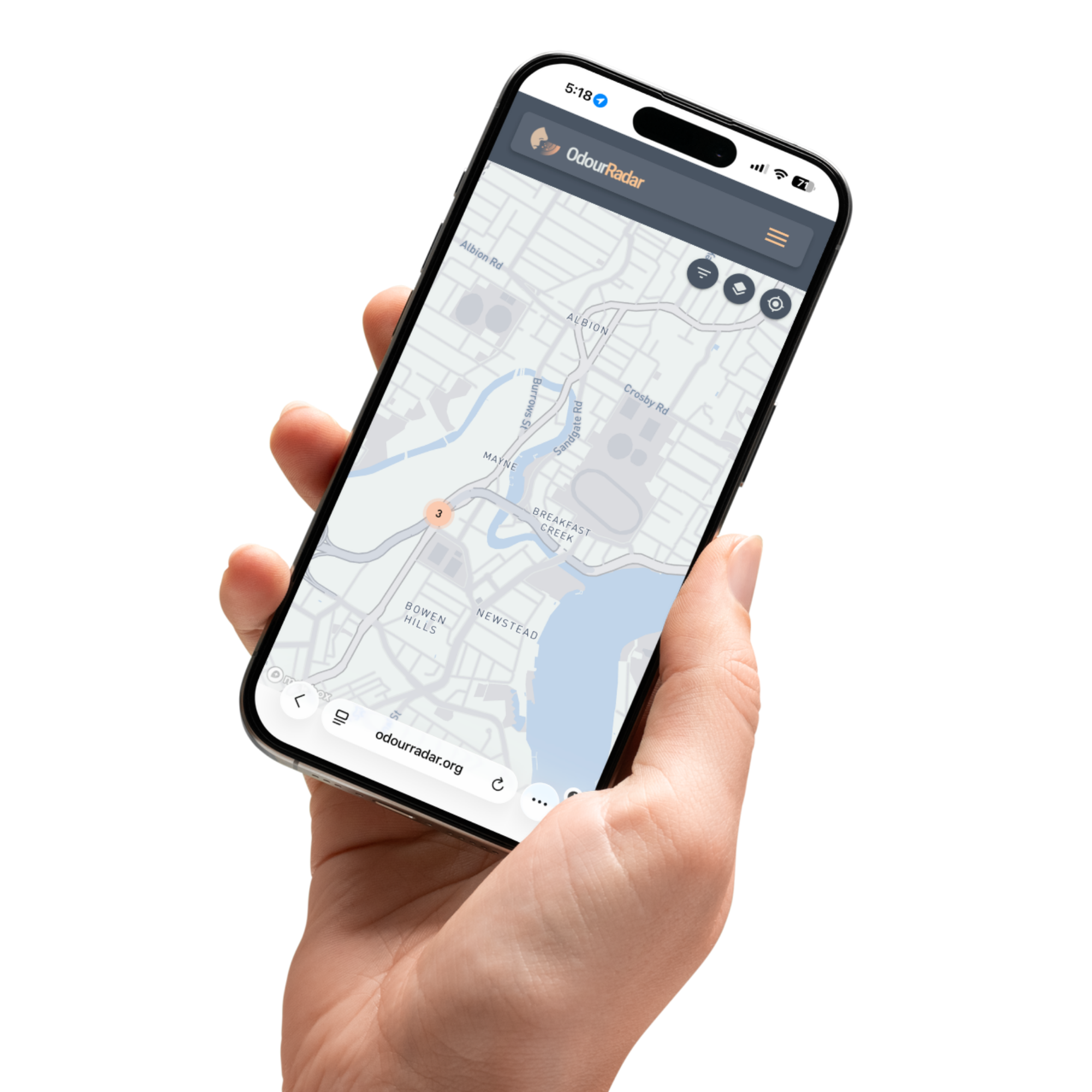
Your location, your data

Pin the exact spot where you experienced the smell. Every tag makes the map more accurate for your community.

More reports, more power

Each submission builds collective evidence. The more residents report, the harder it is to ignore.

Fast and structured reporting

Guided questions mean your report captures exactly what investigators need, first time.

Real-time community picture

See what others in your area are reporting. Understand whether you're alone or part of a pattern.

Supports real action

Structured community data gives local authorities and environmental regulators the evidence to investigate and act.

Why timing matters

The smell at 5am is not the same problem as the smell at noon

Odour complaints are dismissed more often for being vague about when than for being wrong about what. A timestamped report is the difference between an opinion and a data point.

overnight inversion, air stays still06121824Community reports12am3am6am9am12pm3pm6pm9pm60% of reports arrive between 3am and 9am.One person reporting that is a complaint. Forty people reporting it is a pattern, and a pattern is something a regulator can act on.
Illustrative report counts, real physical pattern. The counts here are an example rather than live data, but the early-morning clustering is genuine. Overnight the air goes still and an inversion traps odour close to the ground, so the same emission that disperses harmlessly at midday reaches houses at 5am. It is also why complaints made at breakfast about something that happened at dawn are so easily dismissed without a timestamp.

Swipe the chart sideways to see the full day.

How it works

From one smell to something a regulator can act on

01. You report what you smell

A guided form captures the character, the strength, how unpleasant it was, and exactly where and when. Under a minute, no account of technical knowledge needed.

02. Your report joins the map

Each submission is placed in time and space alongside every other report in your area, so you can see whether you are alone or part of something.

03. The pattern becomes visible

Reports are filtered across time, location and weather conditions. Patterns that no single complaint could show start to stand out.

04. Authorities get usable evidence

Structured, consistent, time-stamped data is what councils and environmental regulators need before they can investigate. Loose complaints rarely clear that bar.

Who runs OdourRadar

The science behind the map

quote

Andrew’s reporting and evidence provided to the court was thorough, clear, compelling and to the point and resulted in the client achieving a successful outcome.

William Gallagher
Principal Lawyer
quote

I would recommend Air Environment for any matter involving the detailed analysis and interpretation of meteorological data and the development of atmospheric meteorological models.

Edie Mather
Development – Australia
quote

Andrew and the team proved to be very flexible and responsive in accommodating changes and providing strategic and technical advice. I would highly recommend Air Environment and will certainly use them again.

Dr Stuart Winchester
Principal GeoEnvironmental Scientist for Energy and Resources
For councils, regulators and site operators

If the complaints are about your site, this works for you too

OdourRadar is written for residents, and that is deliberate. But the reason it is worth having is that structured community data is more useful to the operator than an inbox full of angry emails.

Verify complaints instead of arguing about them

When a complaint arrives, you can see whether it sits inside a pattern or on its own, and what the weather was doing at the time. That is a far better starting position than a phone log.

Show the regulator you are listening

A public reporting channel that produces structured data is evidence of good faith. It is also a lot easier to point to than a promise to do better.

Find the conditions that create your risk

Reports cluster around specific times, wind directions and operational states. Those clusters tell you which sources and which shifts to look at first.

Feed it straight into assessment

Community reports sit alongside field surveillance and dispersion modelling in the same evidence base, handled by the same team.

Faq

Answers to common questions

Common questions about reporting an odour, what happens to your report, and how councils and operators use the data.

Do I need any technical knowledge to report an odour?

None. If you can smell it, you can report it. A guided form asks what it smelled like, how strong it was, how unpleasant you found it, and where and when you noticed it. It takes under a minute.

What does a report actually capture?

The character of the smell, its strength, how unpleasant it was, and the precise location and time. Those last two matter more than people expect, because odour behaves completely differently at 5am than at midday, and without a timestamp that context is lost.

Will one report make any difference?

On its own, one report is a single data point, and we would rather be honest about that than pretend otherwise. What changes the picture is volume and consistency. A hundred reports that all describe the same character at the same time of day under the same wind direction is not a complaint any more, it is a finding.

Can I see what other people are reporting?

Yes. You can see the reports in your area as they build, which is often the first time residents discover that what they have been putting up with is affecting the whole street.

What if the smell has stopped by the time I report it?

Report it anyway, and record the time it actually happened rather than the time you filled the form in. Odour episodes are usually short and the timing is the most valuable thing in the record.

Who runs OdourRadar and who sees the reports?

It is built and operated by Air Environment, an air quality and odour consultancy. Reports are structured so councils and environmental regulators can use them in an investigation.

We are a council or a site operator. Can we use this for our own community?

Yes, that is one of the main ways it is used. Get in touch and we will walk you through how it is set up for a specific site or locality, and how the reporting data connects to field surveillance and dispersion modelling.

Smelling something? Put it on the map.