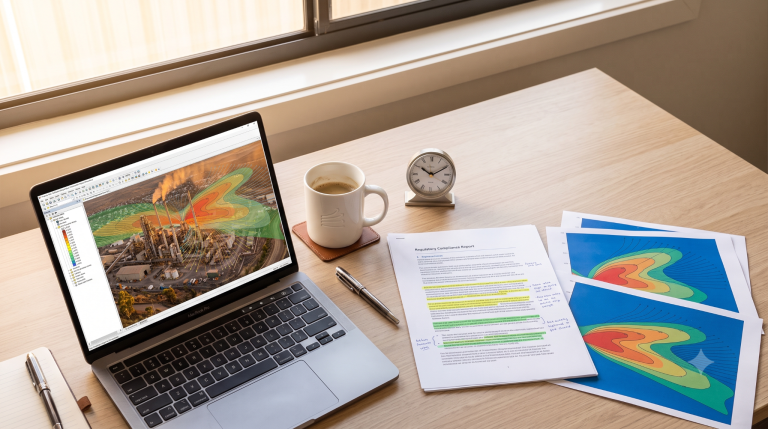
If your facility produces odour, whether from composting, food processing, wastewater or rendering, EPA Victoria Odour Compliance is paying closer attention than it used to.
Odour is no longer treated as a low-priority complaint. It is now a formal compliance issue with real enforcement consequences.
This article explains what has changed, what your obligations are, and what operators can do right now to stay on the right side of the regulator.
Why Odour Has Become a Serious Enforcement Issue
The Environment Protection Act 2017 changed the game for Victorian operators.
Under this Act, every business has a General Environmental Duty. That means you must identify and manage the environmental risks of your activities, including odour, before problems occur.
This is not just a box-ticking requirement. EPA Victoria has built a structured enforcement process around it. Operators who ignore odour risks face escalating consequences.
The regulator does not need a formal exceedance reading to act. A sustained pattern of community complaints is enough to open an investigation. Platforms like OdourRadar help operators capture and respond to complaints systematically, building a documented record that demonstrates good faith.
What Makes EPA Victoria Odour Compliance Tricky
Odour is subjective. There is no single meter you can point at a fence line to get a pass or fail reading.
EPA Victoria builds its evidence through odour diaries, community complaint reports, and field surveillance visits by trained officers. The frequency, intensity and duration of the smell all factor into how they assess impact.
That means your facility’s odour history matters. Each unresolved complaint adds to the record. Over time, that record becomes the foundation of an enforcement case.
What EPA Victoria Can Actually Do to Operators
EPA Victoria uses a stepped enforcement approach. The harder you are to deal with, the further along that scale the regulator moves.
Tools available to the EPA include:
- Remedial notices requiring specific operational changes
- Infringement notices with financial penalties
- Tightened or varied licence conditions
- Suspension or cancellation of operating permissions
- Civil proceedings or criminal prosecution in serious cases
Enforcement outcomes are also published publicly. That reputational exposure can be just as damaging as the financial penalty for many businesses.
One thing that surprises many operators: you are responsible for contractors working on your site too. If a tradesperson causes or worsens an odour problem, your general environmental duty still applies.
The EPA Guidance Operators Should Know
EPA Victoria has published detailed guidance that shapes how both operators and officers approach odour. Knowing these documents puts you in a stronger position.
Publication 1883 – Guidance for Assessing Odour. This sets out three levels of odour risk assessment. It moves from a basic screening check up to detailed quantitative analysis. Operators and consultants use it to structure assessments. EPA officers use it to evaluate whether your site’s odour risk has been properly understood.
Publication 1881 – Guidance for Field Odour Surveillance. This is the playbook EPA officers follow during a site inspection. It covers walk-around assessments, transect surveys and grid-based field methods. If an officer visits your site, this document is guiding their work.
Guidance for Assessing Biofilter Performance If you use a biofilter as odour control, this guidance covers design parameters, operational ranges and how to assess whether it is performing as intended.
Here is the key point: if your monitoring program is designed to a lower standard than what EPA officers apply in the field, that gap is a compliance risk.
What Good Odour Management Actually Looks Like
The facilities that stay out of trouble do not wait for complaints. They build a documented, proactive odour program and keep it current. Tools like PlumeMapper make structured field odour surveying faster and more defensible.
| Service Pillar | Description & Purpose |
| Baseline Odour Characterisation | Identify all sources and measure odour strength under worst-case weather conditions to establish the site context. |
| Dispersion Modelling | Technical modelling to predict how odour travels to nearby receptors, providing the legal basis for compliance. |
| Field Odour Surveillance | Trained assessments to validate predictions against real-world conditions and catch footprint drift early. Our PlumeMapper software is purpose-built for this work |
| NATA-Accredited Olfactometry Testing | Accredited laboratory testing to provide the reliable, defensible data standard expected by regulators. |
| Complaint Tracking and Response | A structured log of complaint conditions and actions as evidence of good faith in investigations. OdourRadar provides an automated platform for capturing and managing this data. |
| Odour Management Plan (OMP) | A formal strategic plan that demonstrates long-term readiness and proactive operational intent to regulators. |
Which Industries Face the Most Scrutiny
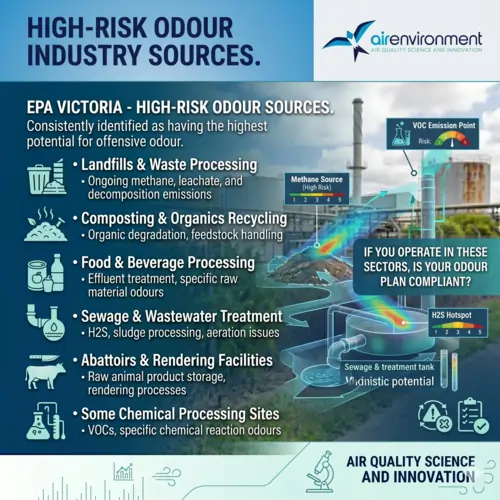
EPA Victoria consistently identifies certain industries as the highest-risk sources of offensive odour. If you operate in any of these sectors, your exposure is real.
Urban growth is making this worse. Residential development keeps moving closer to industrial zones that have operated for decades. The complaints follow, and so does enforcement attention.
Composting facilities face particular scrutiny. EPA Victoria requires a licence to operate, and odour conditions in those licences are actively monitored and enforced.
Reactive Management No Longer Works
Many operators still take a reactive approach: wait for a complaint, respond when contacted, and minimise disruption in the meantime. This made sense under the old regulatory model. It does not work under the current one.
Each complaint that is slowly or poorly handled adds to your evidence file. A pattern of complaints over 12 or 24 months becomes a case. By the time the regulator formally investigates, it is much harder to demonstrate that you have managed the risk responsibly.
Proactive management flips that dynamic. When EPA officers arrive at a facility with solid documentation, reliable data and a clear response history, the conversation is very different. You are showing evidence of control, not trying to explain a pattern of failure.
The cost of a proper odour program is nearly always lower than the cost of an enforcement action, legal proceedings or a forced licence modification.
How Air Environment Supports Victorian Operators
Air Environment is an Australian environmental consulting firm focused on air quality, odour, meteorology and climatology.
We work with operators across food processing, composting, wastewater, resources and manufacturing to build odour programs that hold up under regulatory pressure.
Our NATA-accredited olfactometry laboratory turns samples around faster and produces stronger, more defensible data. That quality directly improves your dispersion modelling and risk assessment outcomes.
Our director Andrew Balch is a Certified Air Quality Professional and a former Chair of the CASANZ Odour Special Interest Group. He is one of Australia’s most experienced odour analysts. Our team also includes former EPA regulators, which means we understand how the compliance process works from both sides.
We have supported clients through EPA investigations, given expert evidence in tribunal and court hearings, and built odour management plans that have survived rigorous review.
If EPA Victoria’s enforcement focus is creating pressure on your operations, or you want to get your odour program sorted before it becomes an issue, we are happy to have a frank conversation about your situation.
Frequently Asked Questions
What is the General Environmental Duty under the Environment Protection Act 2017?
It is a legal obligation that applies to all Victorian businesses. You must proactively identify and manage environmental risks from your operations, including odour. It applies whether or not you hold an EPA licence. The EPA can take enforcement action even if no specific pollution threshold has been crossed.
How does EPA Victoria assess odour complaints?
The EPA reviews complaint reports and odour diaries from the community. Officers also conduct field surveillance using standard assessment methods. They look at how often the odour occurs, how intense it is, how long it lasts, and how offensive it is to those affected. A consistent complaint pattern can trigger a formal investigation.
What is olfactometry and why does it matter for compliance?
Olfactometry is the lab-based measurement of odour concentration. A trained panel of human assessors sniff diluted samples to determine the odour level in odour units. NATA-accredited olfactometry is what Australian regulators expect. Data from uncertified or poorly controlled programs is unlikely to survive scrutiny.
Which industries are most likely to face EPA Victoria odour enforcement?
Landfills, composting facilities, food processing plants, sewage treatment works, abattoirs and rendering operations sit at the top of the risk list. Any facility with a history of community complaints is exposed to enforcement attention, regardless of industry type.
Do I need an odour management plan if I do not hold an EPA licence?
Yes, in practice. The General Environmental Duty means unlicensed operators still carry odour management obligations. A documented plan shows the regulator that you have understood and addressed your risks. Without one, you have no paper trail to support your position if complaints escalate.
Air Environment is an Australian environmental consulting firm specialising in air quality, odour, meteorology and climatology. Our scientists and NATA-accredited processes support industrial and commercial operators across Australia with odour assessments, dispersion modelling, field surveillance and regulatory compliance.