Quick Summary
- An odour assessment is a structured technical investigation involving source sampling, odour concentration analysis by dynamic olfactometry, dispersion modelling, and field ambient odour surveys — not a simple site inspection.
- Odour concentration is measured in odour units (ou) against AS EN 13725 using NATA-accredited laboratories.
- A dispersion model runs thousands of real meteorological scenarios to map how often odour reaches surrounding properties.
- Each state has its own regulatory framework — DETSI in Queensland, EPAs in Victoria, NSW, Tasmania, South Australia and the Northern Territory, and DWER in Western Australia all have different approaches and set different thresholds to assess odour impact.
- Assessments evaluate typical and worst-case site operations, not best-day performance, so preparation does not change the outcome.
An odour assessment Australia-wide is not someone sniffing around your site and writing a report. It is a structured, technical investigation — and understanding what it actually involves can save you a lot of time, money, and regulatory grief.
Most people arrive at the need for an odour assessment for one of two reasons. Either they are seeking approval for a new development and the planning authority has requested one, or issues have already emerged — complaints are being received, the EPA has become involved, and pressure is mounting to show that the site is being managed properly. Then there is a third group — smaller, but often the smartest — who commission an assessment before either of those situations occurs.
What all three need is the same thing: a defensible, evidence-based answer to the question of whether odour from the site is causing an unacceptable impact on the people around it.
What the process actually involves
For existing operations, the assessment begins with a detailed review of the site by an air quality specialist. This may involve a site inspection, a desktop review of site information, and discussions with operators and managers to understand processes and potential odour sources.
Once the key emission sources have been identified, a source odour sampling program is developed or a field odour surveillance program is designed. The sampling program must not only define where and how odour emissions will be measured, but also how the resulting data will be used to evaluate community impacts. Depending on the objectives of the emissions monitoring study, this may include dispersion modelling, ambient odour surveillance, or other emission verification techniques.
Samples are collected from whatever is generating the smell — stacks, open surfaces, storage areas, process vessels — and sent to an accredited odour laboratory where trained human panellists determine the concentration. The result is expressed in odour units, measured against the Australian standard AS EN 13725. That number, on its own, tells you almost nothing useful. A high concentration at the source does not mean neighbours are being affected. A low one does not mean they are not.
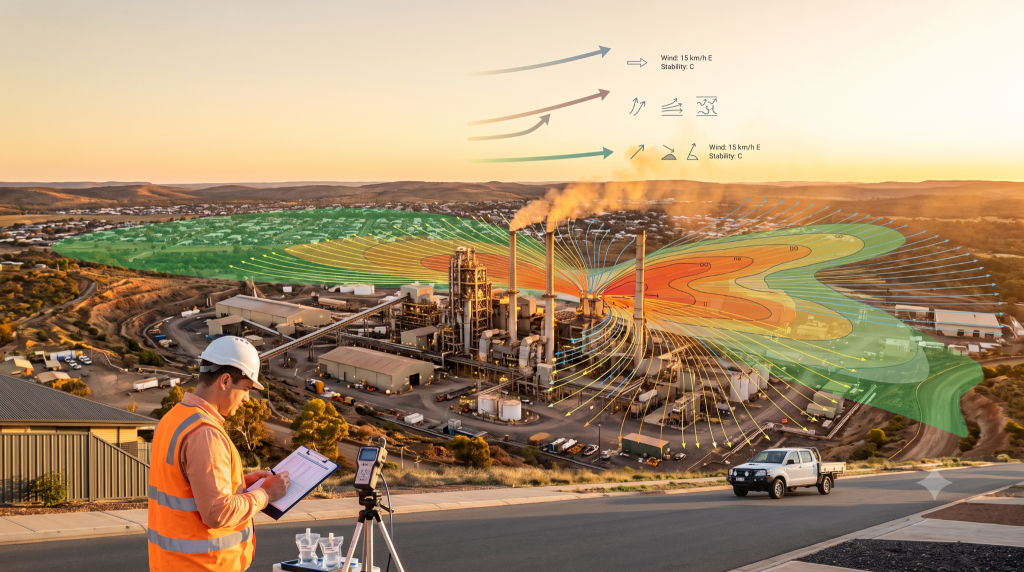
What ultimately matters is not the odour at the source, but what happens after it is released into the atmosphere. Dispersion modelling combines measured odour emissions with at least a year of meteorological data, sometimes many years — including different wind speeds, wind directions, atmospheric conditions, times of day and seasons — to predict how odours will behave in the surrounding environment.
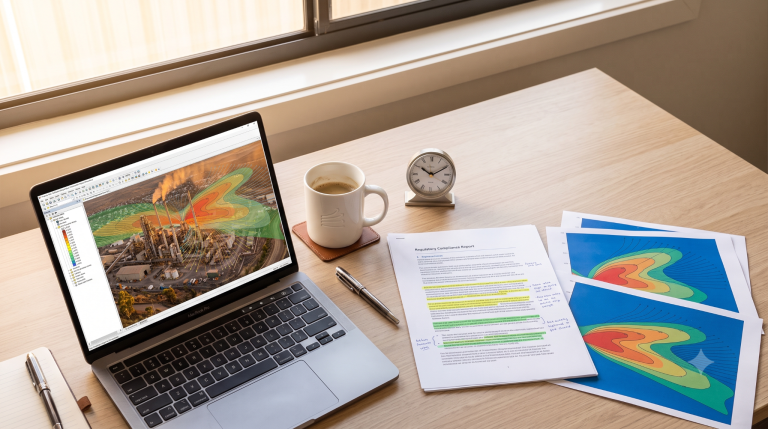
The results are typically presented as contour maps showing the extent of the odour plume or the frequency with which odour criteria are predicted to be exceeded at surrounding properties. These predictions help identify where odour impacts are most likely to occur and whether a facility can meet regulatory performance requirements. Importantly, dispersion models are designed to test a site’s performance under the full range of meteorological conditions, including those most likely to result in off-site odour impacts.
The quality of meteorological input is critical here. Generic national weather data is not sufficient for a site with complex terrain or unusual local wind patterns. Proper meteorological assessment specific to the site location makes the difference between a model that reflects reality and one that flatters it.
Field surveys and what they add
Field surveys add a layer that modelling alone cannot replace. Trained assessors visit the surrounding area at different times, recording whether odour is detectable, how strong it is, and what character it has. This grounds the assessment in lived experience rather than theoretical outputs. It also picks up things a model will miss — intermittent sources, operational quirks, seasonal variation in how the site behaves.
How the results are used
The final report benchmarks everything against the relevant criteria for your jurisdiction and land use. That benchmark varies by state and by context. What is acceptable adjacent to an industrial estate is not acceptable next to a residential suburb. Each state has its own framework, for example, Victoria operates under the Environment Protection (EP) Act 2017, NSW under the Protection of the Environment Operations (POEO) Act 1997, and Queensland under the Environment Protection Act 1994 [1], and each has its own subordinate odour policies and guidelines — which define how odour from industrial premises is assessed against community amenity standards and is one of the key references shaping how odour assessment Australia-wide is conducted. Our odour assessment services are calibrated to meet the requirements of each jurisdiction, including EPA Victoria’s odour enforcement framework, which uses community complaint history, field surveillance, and modelled exposure as a combined evidence base.
Under the Environment Protection Act 2017, Victorian operators carry a General Environmental Duty. You are expected to understand and manage odour risk before problems occur, not after. Queensland’s odour policy mirrors this in intent — operators must demonstrate proactive management, not just respond to complaints.[2]
One misconception worth addressing
An odour assessment is not a pass/fail test you can prepare for. You cannot clean up for it. The process is designed to capture how the site typically operates, not how it performs on its best behaviour. Operators who have cut emissions for the sampling period and returned to normal have generally not found that approach to end well.
The scope also varies significantly. A small food manufacturer seeking a planning permit in a light industrial zone needs something very different from a large composting facility expanding near suburban housing. Getting the scope right at the outset — rather than having it challenged by a regulator or planning authority later — is worth a conversation with a specialist before anything is commissioned.[2] See how Air Environment approaches odour impact assessment and complaint response for sites already dealing with regulatory pressure.
Get in touch with the Air Environment team to discuss what level of assessment your project requires.
FAQ
How long does an odour assessment take?
It depends on the scope, but most assessments involving sampling, dispersion modelling, and a field survey take between four and ten weeks from site visit to final report. Complex sites or those with multiple emission sources can take longer.
Do I need an odour assessment for a development application?
Not always, but it is required in most Australian jurisdictions for any development that generates odour and is located near sensitive receptors such as residential areas, schools, or hospitals. Your planning authority or planning consultant can confirm what applies to your project.
What is the difference between an odour assessment and an air quality assessment?
An odour assessment focuses specifically on nuisance odour — whether smells are likely to affect nearby residents or workers. An air quality assessment is broader and covers pollutants that may affect health, including particulates, criteria pollutants (typically from combustion sources), and hazardous air pollutants (HAPs) such as VOCs, PAHs, metals and dioxins/furans. The two are often conducted together for industrial sites.
Which Australian standard applies to odour sampling and measurement?
Odour testing in Australia is conducted in accordance with AS EN 13725, which specifies the method for determining odour concentration and emission rates using dynamic olfactometry. Point source sampling from stacks and vents is also covered under AS EN 13725, while area source sampling from solid or liquid surfaces is sampled according to the AS/NZS 4323.4 method.
What happens if an odour assessment shows the site is non-compliant?
The report will typically identify what operational changes, engineering controls, or separation distances would bring the site within acceptable limits. This forms the basis for a management plan or a revised development proposal.
References
[1] Department of Environment and Science, Queensland. EPA QLD Odour Policy. https://www.des.qld.gov.au
[2] Environment Protection Authority Victoria. (2021). Odour assessment guidelines: Development and planning. EPA Victoria. https://www.epa.vic.gov.au