

Inside Air Environment’s Odour Laboratory
At first glance, an odour laboratory can seem faintly comic – a room full of people paid to sniff air for a living – but the reality is that it’s one of the more exacting streams of air quality science.
In the moment before the session begins, the room falls quiet.
Six panellists sit at stainless steel workstations, eyes forward, waiting. Three ruthlessly clean ports line up in front of them like something from an aircraft cockpit. Somewhere behind the wall, an air compressor hums softly as the next presentation in the dilution series to be smelt is prepared.
The air is clean – deliberately, obsessively clean.
Then, in controlled bursts, the smells arrive.
Welcome to Air Environment, where detecting a whiff of livestock or industrial rendering is not a nuisance, it’s the job – part sensory analysis, part engineering discipline, part quality-management.
“It’s not exactly glamorous,” says company director Andrew Balch, “But it’s oddly satisfying. And once you start thinking about how smell works, you don’t stop noticing it. Ever.”
The business of our most emotive sense
Odour is one of the most subjective parts of air quality management. It elicits powerful emotions. It is immediate. And often, it is what triggers the first complaint from a nearby community.
But environmental regulators do not deal in emotions. They deal in evidence.
That’s where air quality organisations like Air Environment come in – translating lived experience into hard data that can stand up to scrutiny and turn the subjective into the highly objective.
“Odour assessment is part air quality science and part human psychology,” says Balch. “Our job is to utilise our odour lab in a way that takes the subjectivity away from what is a human biological process.
“I have a degree in atmospheric science, with an understanding of air emissions, meteorology and plume dispersion characteristics. But I have always thought that to understand the community’s reaction and perception to odour, a psychology degree would be more useful.”
A room full of human sensors
Despite the hardware, the most important instrument in the lab is human.
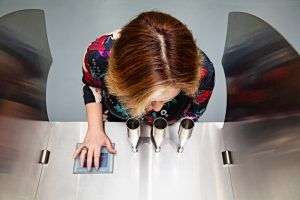
Odour testing relies on trained panellists whose sense of smell is calibrated, tracked and kept within strict bounds. In effect, they are regulated smell detectives.
That introduces an unusual kind of quality control. Sensitivity must be consistent. Performance must be monitored. Even lifestyle factors can creep into the equation.
“Try telling someone their nose is out of spec,” Balch says. “It makes for an interesting performance review.”
Pressure behind the scenes
The stakes extend well beyond the lab walls.
Results can inform major planning decisions, EPA compliance or investigations into community complaints. Regulators need numbers – defensible, repeatable, and scientifically robust.
Every run, every session, every result carries weight.
Plus, timelines are tight. Odour samples are degradable.
Odour samples require very exacting handling and storage standards to extract scientifically-sound results.
“The samples we collect must finish being tested within 30 hours to meet regulatory standards,” Balch says. “This ensures potentially unstable compounds are tested before they can alter or degrade in the collection bag.”
Where the standards take over
Behind the scenes, the science is governed by rigorous frameworks.
Odour laboratories operate within NATA accreditation structures aligned to ISO/IEC 17025, ensuring quality results that are traceable and technically exemplary.
At the centre sits AS EN 13725:2025, Australia’s adoption of the European EN 13725:2022 standard for odour measurement.
The method uses dynamic olfactometry and derives results based on the dilution required for detection. This is expressed as odour units, or ou (the Australian equivalent of European odour units per cubic metre, or ouE/m³).
In simple terms – this means how much clean air you need before the smell is undetectable to 50% of the population.
“That’s the odour’s threshold,” Balch says. “And that’s central to what Air Environment’s odour lab does.”
The machine that makes it possible
At Air Environment, that threshold is measured using a Scentroid SS600 olfactometer.
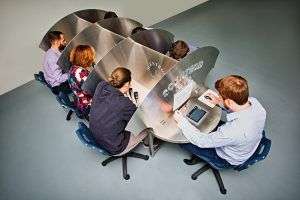
The system is a six-station dynamic olfactometer, allowing simultaneous testing by multiple panellists.
It precisely blends odorous samples with certified clean air, delivering stepped dilutions in controlled presentations so each analysis is a tightly managed sequence.
“But the olfactometer is the easy bit,” Balch says. “The discipline around it – how it’s managed, maintained and operated – that’s where labs live or die.”
Laboratories need to be exactingly controlled environments, brutally sanitised and odourless. And there are many pieces of equipment the olfactometer relies upon that must be maintained with an eye for precision.
| What is olfactometry? Olfactometry is the scientific measurement of smell. In environmental science, it typically refers to dynamic olfactometry, the method defined under standards like EN 13725. How it works – in plain terms:
Because the ultimate impact of odour is human perception. The method is designed to reflect what people actually experience, rather than just chemical composition. There is no machine yet that can do a similar quality job. What it produces: A numeric result expressed as ou, representing how strong the odour is relative to the detection threshold. |
Calibration: keeping the nose honest
Because odour testing relies on human perception, calibration becomes crucial – and surprisingly complex.
It is about aligning both instrument performance and human response to a known reference.
The standard method uses a reference substance – typically n-butanol – delivered through the olfactometer at controlled concentrations. Each panellist’s olfactory acuity is tested before they are accepted onto a test panel, and this perceptive ability is continually tested and monitored throughout their career to confirm their detection thresholds sit within an acceptable range defined by the standard.
Calibration is less a single event and more a continuous discipline – repeated, documented and audited.
At the same time, the lab and equipment within it must demonstrate precision and accuracy, ensuring that the testing is reliable and repeatable.
That means:
- Checking the equipment and lab environment for integrity.
- Running blank tests to ensure there is no residual odour.
- Maintaining traceable records of performance.
“It’s not enough to determine a number,” Balch explains. “You need to show how defensible that number is. It’s like running a forensic lab for smells. Everything has to stand up to scrutiny.”
A strange kind of precision
Odour science sits in an unusual space – part engineering, part psychology, part environmental regulation.
It measures something deeply human using deliberately rigid frameworks.
“You need people who are methodical and calm,” Balch says. “And people who don’t second guess what they are experiencing.
“For Air Environment, it’s about more than smell. It is about giving regulators confidence, helping industry operate responsibly and translating human experience into defensible science.”
Beyond the nose
Outside the lab, odour is emotional. Inside, it is controlled, repeatable and measured.
“You can’t assess odour on emotion,” Balch says. “That intangibility happens out in the community. But in the lab, it’s about turning that abstract into irrefutable numbers and defensible science.”
And in that contradiction lies the real work for Air Environment’s odour laboratory – turning something fleeting into something unquestionable, one carefully measured sniff at a time.
